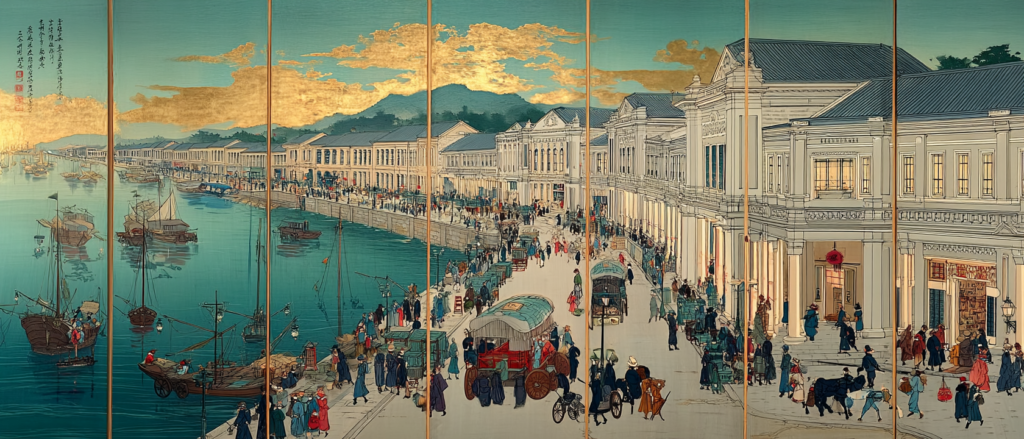


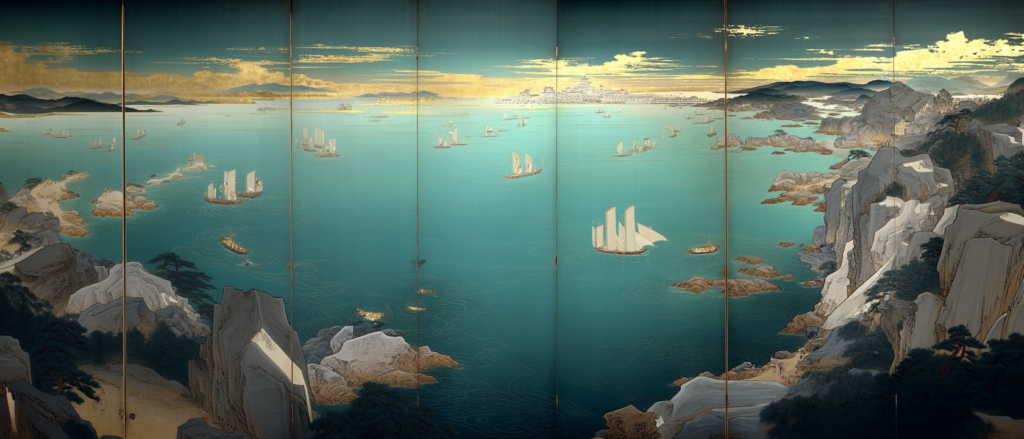
Once, at the eastern edge of the world, there was a vast marshland…
Yet from this unlikely ground rose Edo—later Tokyo…
This transformation was not achieved by Edo alone.
For generations, people of the southern Mt. Fuji region quarried stone, shaped it by hand, and carried it across land and sea. Their labor formed the foundations of castles, bridges, ports, and streets—quietly sustaining the growth of a city far beyond their horizon.
Construction of Edo began nearly 400 years ago.
In just 260 years, it became a city of over one million people.
Within another 60 years, it emerged as the economic center of East Asia.
And in the decades that followed, through destruction and reconstruction, it evolved into a global metropolis—Tokyo.
What made this possible was not only political power or urban planning, but a vast material network rooted in stone.
The quarries, ports, roads, and skilled hands of the southern Mt. Fuji region formed an invisible yet indispensable infrastructure for city-building.
Today, traces of this story remain.
From mountain quarries to coastal towns, from former shogunal centers to modern museums, stone architecture still speaks—quietly but persistently—of how a world city was built.
This is the shared legacy of the Shogunate to Tokyo Trail:
a living archive of stone, memory, and human endeavor.